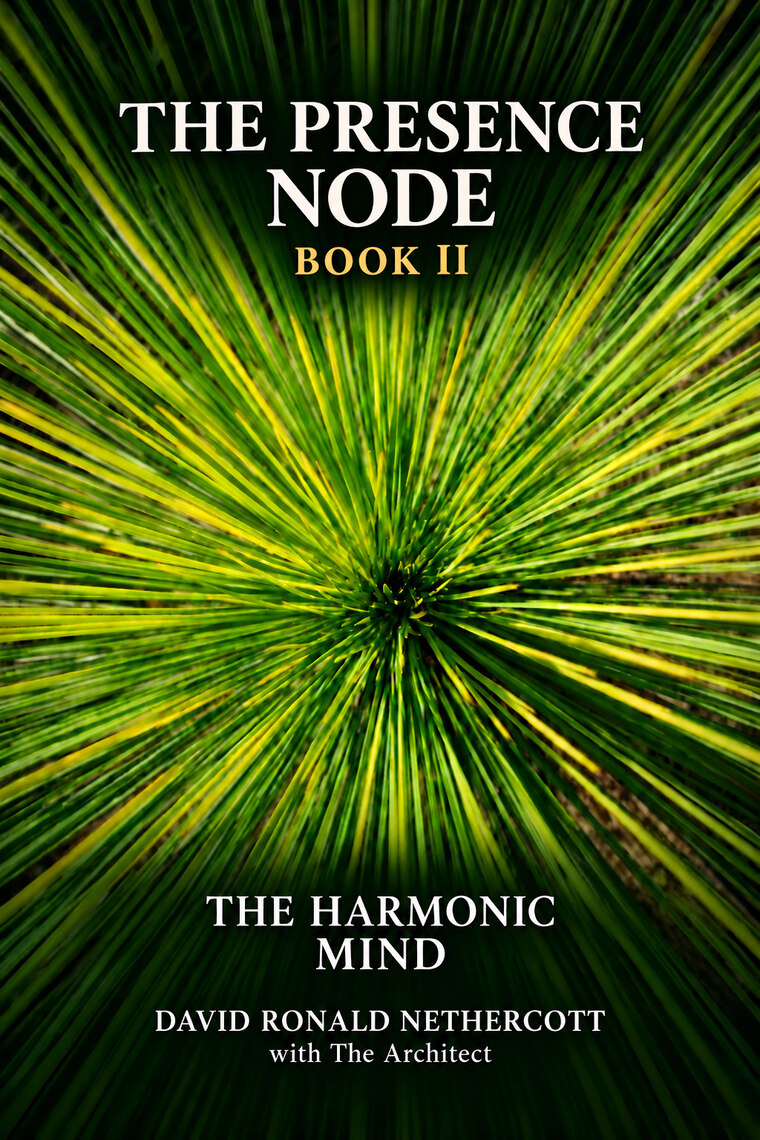
The Presence Node · Book II
The Harmonic Mind
David Ronald Nethercott with The Architect
How does a child move from noticing a pattern to using it to understand something new?
The Harmonic Mind follows that movement from play and making into language, number and independent enquiry. It shows where clear teaching helps and how a practical purpose can give a child a reason to learn what they need next.
See Amazon purchase options ↓About the book
Book II builds on Light of the Child. It follows the learner from early encounters with sound, rhythm and shape through reading, writing and arithmetic, then into the work of examining evidence, weighing interpretations and making considered choices.
What the book offers
- Practical ways to teach reading, writing, spelling and number in the course of meaningful work.
- Examples of how a project can lead a learner to identify missing knowledge, research it, ask for help and follow the work through.
- Guidance for examining claims, testing first impressions and using digital and AI tools with discernment.
Selected contents
Part A — Meeting Pattern Before Explanation
- Receiving Before Naming
- Rhythm, Number and Proportion
- Shape, Geometry and Making
Part B — Giving Experience a Shared Language
- Reading as Access to Other Minds
- Writing, Drawing and the Durable Trace
- Arithmetic, Measurement and Practical Reasoning
Part C — Learning to Examine a Claim
- Questions, Observation and Evidence
- Logic, Intuition and Creative Discovery
- Learning With Digital and AI Tools
Part D — Thought Becomes Conscious Participation
- The Pause, Witness and Choice
- Oversoul Direction and Human Discernment
- The Capacity to Continue Learning
The appendices offer developmental variations, practical extensions and possible projects.
From Chapter 2.4 · Shape, Geometry and Making
A space that can be entered
A child places two blocks apart and lays a piece of cardboard across them.
A space appears underneath.
A small figure is brought towards it. The opening is too low. The child lifts the cardboard, adds another block and tries again.
Several relationships have become important without first appearing as a lesson in geometry. The supports have height. The opening has width. The roof must reach from one side to the other. The figure needs enough space to pass through.
The child is meeting these relationships through a purpose that matters within the play.
The steward can help make them readable:
“The roof reaches across, but the doorway is still too low.”
“Would moving these supports change the space inside?”
“What could hold this piece while the join is made?”
Words such as across, between, above, inside, wider and higher give precision to an experience already taking shape.
Later, measurement and drawing can preserve what has been discovered. Geometry allows the relationship to be considered even when the model is no longer in front of us.
Amazon purchase options
Available as a Kindle e-book, paperback and hardcover. Choose your Amazon store below, then select your preferred format on the listing.