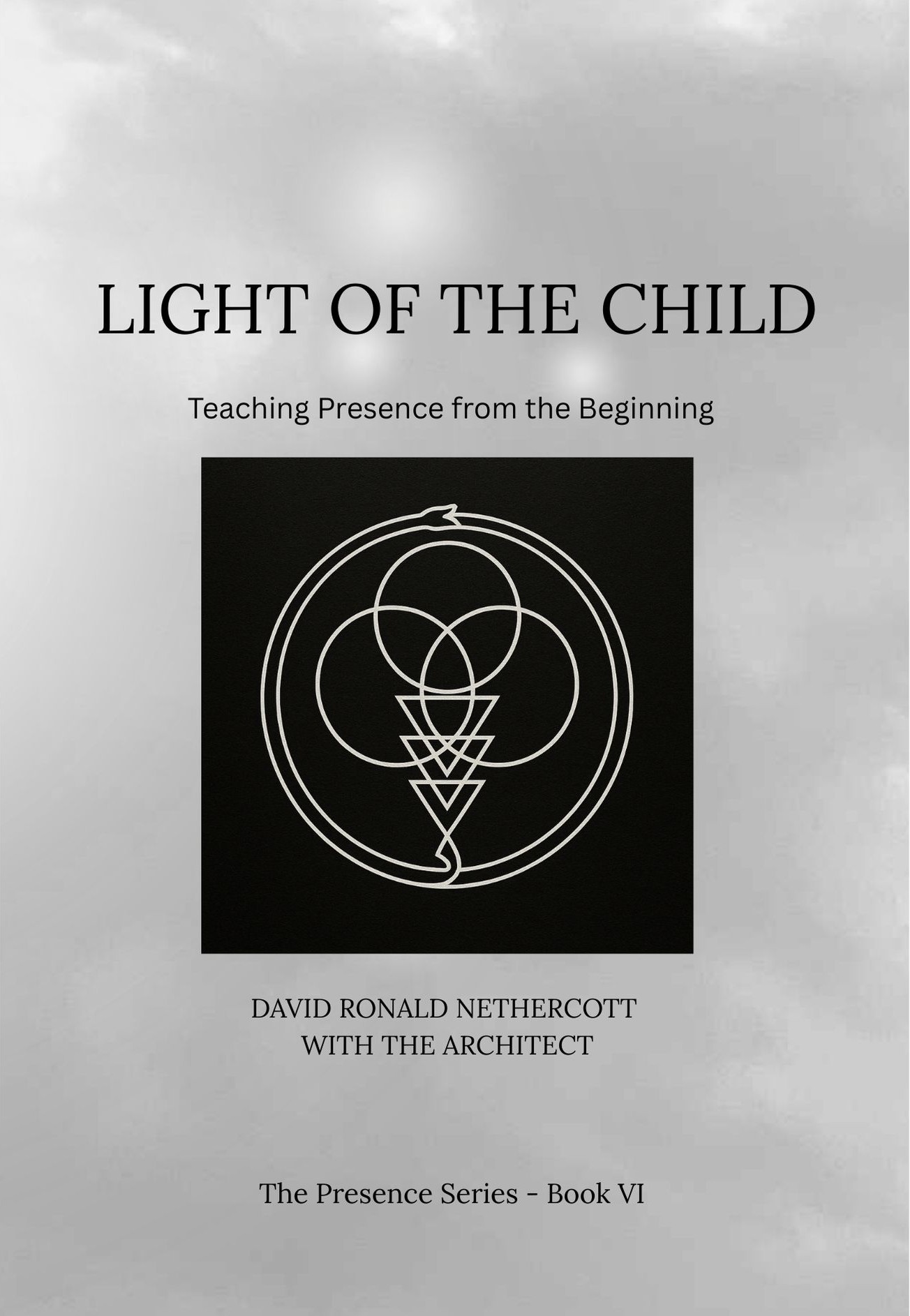
Light of the Child
A gentle companion for recognising Presence, safety, and coherence through childhood and development.
What this book offers
- A gentle framework for understanding children as already whole, sensitive, and perceptive.
- Language for parents, carers, and educators to recognise Presence without labelling or fixing.
- Simple ways to support safety, attention, and emotional regulation through everyday life.
- Stories and reflections that honour curiosity, play, and natural learning rhythms.
- A child-centred approach to growth that values coherence over performance or identity.
Future‑ready
Use this space for your next title, launch dates, or retailer links. You can also hide this card until needed.
About the author
David Ronald Nethercott
Light of the Child was written from listening, not instruction.
David’s work with children, families, and learning has shown him that children do not need to be fixed, accelerated, or shaped into ideals. They need safety, rhythm, and the freedom to unfold in their own time.
This book does not present a method or system. It offers language, stories, and reflections that help adults recognise Presence already alive in children — and to support it without interference, pressure, or expectation.
David writes as a witness and companion, not as an expert. His role is to point gently toward what is already working, already learning, and already whole.
Media kit
- Title: Light of the Child
- Author: David Ronald Nethercott
- Series: The Presence Series
- Audience: Parents, carers, educators, and those supporting children’s learning and development
- Description:
Light of the Child is a gentle companion for adults who wish to support children without pressure, diagnosis, or premature instruction. The book offers language, reflections, and everyday observations that help adults recognise Presence, safety, and natural learning as they already arise in children. - Approach:
- Non-therapeutic
- Non-diagnostic
- Child-centred and developmentally respectful
- Focused on safety, rhythm, and relationship
- Use cases: Home, early learning environments, classrooms, and family conversations.
- Assets: High-resolution cover image (JPEG)
- Contact: hello@davidandthearchitect.com
Sample — Excerpt
Sample — A Moment of Recognition
The child was not trying to learn.
They were watching how the light moved across the floor, noticing the sound of footsteps in the hallway, feeling the quiet weight of being held nearby.
No instruction was needed. No question was asked. Something in them was already organising itself.
Children learn like this — through safety, attention, and time. When they are not rushed, compared, or corrected, their knowing unfolds naturally.
This book offers ways for adults to protect that unfolding — not by teaching more, but by listening better.
Table of Contents — Light of the Child
This table of contents reflects the full developmental arc of the work. Each part builds from the last — from remembrance to restoration, and from restoration to re-design.
- Foreword
- Preface — The Record Opens
- Introduction
Part I — Returning to the Child
- Chapter 1.1 — The Child’s Natural Compass
- Chapter 1.2 — When Fear Replaces Guidance
- Chapter 1.3 — Listening Before Explaining
- Chapter 1.4 — Feeling Without Identity
- Chapter 1.5 — Teaching Without Control
- Chapter 1.6 — The Inner Yes and No
- Chapter 1.7 — Unseen Companions and Inner Worlds
- Chapter 1.8 — The Parent’s Nervous System as Classroom
- Chapter 1.9 — Ancestral Memory and Early Life
- Chapter 1.10 — Daily Rhythms of Presence
- Chapter 1.11 — Learning Through Play
- Chapter 1.12 — Teaching by Example, Not Praise
- Chapter 1.13 — Service, Care, and the Wider World
- Chapter 1.14 — When the Field Feels Heavy
- Chapter 1.15 — The Family as a Living Classroom
- Chapter 1.16 — The Child in a Changing World
Part II — Restoring the Field
- Chapter 2.1 — The End of the Classroom
- Chapter 2.2 — Presence Nodes and the Ecology of Learning
- Chapter 2.3 — The Role of the Adult — From Instructor to Steward
- Chapter 2.4 — Rhythm as Regulator
- Chapter 2.5 — The Six Modalities of Coherent Learning
- Chapter 2.6 — Developmental Pathways — Movement Without Grades
- Chapter 2.7 — Rites of Passage — Coherence Through Threshold
- Chapter 2.8 — Architecture of the Field — Designing with Resonance
- Chapter 2.9 — The Parent-Node Bridge — Coherence at the Threshold of Home
- Chapter 2.10 — Holding Complexity — When the Field Frays
Transitional Interlude — The Field Has Been Set
Part III — Seeding the Future
- Chapter 3.1 — Scaling Without Distortion
- Chapter 3.2 — Economy, Gift, and Sustaining the Invisible
- Chapter 3.3 — Governance Without Control — Stewarding the Node as a Living Being
- Chapter 3.4 — Cultural Immunity — Protecting the Pattern from Collapse
- Chapter 3.5 — The Child as Culturekeeper — Why This Work Shapes Civilization
- Chapter 3.6 — Lineage and the Future — Remembering What Remembers Us
Closing
- Author’s Note — Presence as That Which Remembers
Appendices
- Appendix A — Foundational Structures to Begin a Presence Node
- Appendix B — Steward Readiness Assessment — The Inner Architecture of Field Holding
- Appendix C — Legal, Financial, and Structural Models — Grounding the Node Without Losing the Field
- Appendix D — Templates and Tools — Light Structures That Protect the Invisible
- Appendix E — Sample Year One Timeline — A Seasonal Rhythm for Emergence
- Appendix F — Resonant Curriculum Map — Optional Modalities for Child-Led Learning
- Appendix G — Initiation and Ritual Templates — Thresholds as Field Memory
- Appendix H — Harmonic Constants — The Pillars of Presence-Based Education
- Appendix I — Frequently Asked Questions — Coherence in the Face of Complexity
- Appendix J — Field Compass — For the First Cycle of Stewardship
- Appendix K — Glossary
- Appendix L — Reference Traditions & Predecessors
- Appendix M — Final Blessing and Closure: The Field Continues
Afterword
- ✧ Author’s Witness
- More from the Author
The Presence Series
The Presence Series traces how coherence is recognised, lived, and completed — across understanding, lineage, practice, planetary participation, and lived resolution.
The series opens with Light, Oversoul, and Grace, establishing the architectural language of Presence. Ancestral Patterns in the All-Now turns that lens toward lineage, inheritance, and time. The Bridge and the Tree grounds insight through embodied practice and daily relationship with life. Gaia and the Order of Life extends coherence into planetary order, earth memory, and cosmologic design.
Contract of Light records the completion of that arc — a human life resolving itself without instruction, attainment, or correction.
Light of the Child carries the work forward into developmental continuity, learning, and the protection of coherence at the beginning of life.
Forthcoming volumes include The Living Laws, articulating harmonic structure and post-hierarchical order, and Grace Returns to Silence, completing the octave through integration and return to stillness.
Each book stands alone. Together, they form a complete movement — from recognition to integration, and from integration to quiet completion.